• Jump to Header
  • Jump to Main Content
  • Jump to Footer
Michigan State University
Capital Planning and Space Administration
  • Spartan Space
  • Inclusive Campus Maps
  • Policies & Procedures

Capital Planning and Space Administration

  • Home
  • |
  • Planning Processes
    • Alterations and Improvements
    • Capital Planning Transformation
    • Teaching and Learning Environment
  • |
  • Space and Facilities
    • Classroom Scheduling
    • Multidisciplinary Buildings
    • Space Requests
    • Spartan Space
  • |
  • Training and Resources
    • Capital Outlay
    • Inclusive Campus Maps
    • Policies and Procedures
    • Space Analytics and Metrics
  • |
  • Contact Us
    • Staff Directory
Capital Planning and Space Administration
  • Home
  • Planning Processes
  • Space and Facilities
  • Training and Resources
  • Contact Us

< Home

< Planning Processes

  • Alterations and Improvements
  • Capital Planning Transformation
  • Teaching and Learning Environment

< Space and Facilities

  • Classroom Scheduling
  • Multidisciplinary Buildings
  • Space Requests
  • Spartan Space

< Training and Resources

  • Capital Outlay
  • Inclusive Campus Maps
  • Policies and Procedures
  • Space Analytics and Metrics

< Contact Us

  • Staff Directory
  • Spartan Space
  • Inclusive Campus Maps
  • Policies & Procedures

Teaching and Learning Environment (TLE)

Capital Planning and Space Administration > Planning Processes >

Teaching and Learning Environment

Teaching & Learning Environment (TLE) Planning and Spending Guidelines

(Updated July 2022)

Purpose of the TLE Fund

The Teaching and Learning Environment (TLE) fund is a strategic allocation designed to build and transform the university’s educational technology infrastructure in ways that enhance student learning and contribute to the distinction of the MSU curriculum.

Two categories of TLE funding are available:

Strategic Investment Projects

Strategic Investment Project (SIP) funding supports innovative projects and initiatives that are aligned with the long-term strategic priorities of the colleges and the university. This is the largest available pool of funding in the annual TLE budget.

Maintaining Technological Effectiveness

Another key use of TLE funds is to upgrade and refresh the existing technology environment, especially in areas that are accessible to all students. Maintaining Technological Effectiveness (MTE) funds are divided into seven sub-categories of support (in order of funding priority): classroom and laboratory upgrades, virtual learning environment, teaching and evaluation tools, graduate education, library resources, faculty computing and other infrastructure.

About the TLE Fund and Process

Annual Planning Process & Calendar

TLE funding is part of the annual integrated general fund planning and budget process. TLE requests are considered based on alignment with programmatic planning and facilities alterations and improvements (A&I) needs.

The TLE process begins with the announcement of the Provost’s request for proposals in early January of each year. Major Administrative Units (MAUs) are asked to complete the funding request narrative and budget template and follow the submission instructions provided to forward their prioritized request(s) to the Provost’s Office, President, or Executive Vice President.

Funding requests are reviewed for alignment with university strategic goals and priorities, readiness for implementation and appropriateness for TLE funding. Resources that faculty and students use directly in instruction and learning are most suitable for inclusion in proposals. Research or administrative resources generally are not eligible for TLE funding. Additionally, units are expected to plan for integrating maintenance and replacement of new infrastructure into their existing local operating budgets.

The Provost and Chief Information Officer collaborate to allocate TLE funds as part of the annual budget process facilitated by Capital Planning and Space Administration in coordination with MSU IT Services. Approved funding allocations are announced to MAU leadership via their budget materials and TLE communications. MAU leaders are responsible for informing departments of approved requests and communicating account information and spending guidelines.

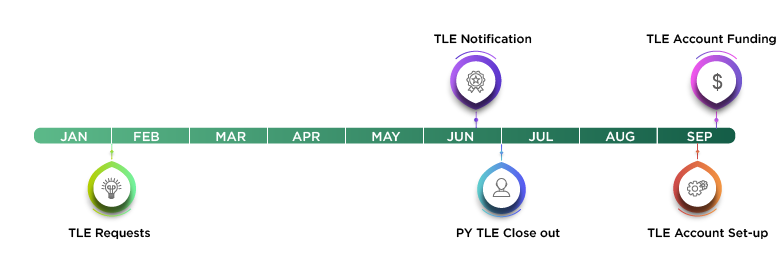
TLE calendar: TLE Requests end of January. TLE Notification in June. PY TLE Close Out end of June. TLE Account Set-up in September. TLE Account Funding in September.
Strategic Emphasis

We continue to refine the TLE planning and funding process to optimize the use of available funds and expedite the modernization of campus-wide teaching and learning resources.

The greatest share of TLE funding will continue to go toward innovative projects aligned with university strategic priorities for enhancing the student experience. Units have been encouraged over the past several years to build the replacement of basic computing infrastructure, such as faculty computers, into their operating budgets versus requesting funds from TLE sources for this use. Non-faculty workstation/computer replacements and any type of payroll (e.g., students and staff) are not typically allowed expenses with TLE funds.

Accelerated Repurposing of Unspent Funds

TLE funding is designed primarily for projects that are ready for implementation within the course of the funding year. Carrying forward unspent account balances ties up funds that could be used to mitigate the negative effects of many years of deferred maintenance of our IT infrastructure. The default action at fiscal year-end will be to sweep remaining fund balances on all accounts, including MTE accounts, and expire and close any remaining SIP accounts. Occasionally, remainders of SIP awards may be carried forward into a second fiscal year to complete a project (for example, a classroom renovation with a summer completion date). Colleges should contact Capital Planning and Space Administration (capitalspace@msu.edu) with a copy to IT Services (ITServices.Finance@campusad.msu.edu) to request an extension of a SIP account. Special requests to carry forward MTE funds beyond the current fiscal year should also be sent to the Capital Planning and Space Administration (capitalspace@msu.edu) with a copy to IT Services (ITServices.Finance@campusad.msu.edu).

Roles & Responsibilities


IT Services partners closely with academic units, the Office of the Provost, Capital Planning and Space Administration, and Infrastructure Planning and Facilities to plan, design, coordinate and execute the IT elements of strategic projects and infrastructure maintenance.

As academic units begin to identify and prioritize technology projects that are large-scale or high impact, they should contact IT Services for technical support and guidance in adhering to university standards. In the long-term, collaboration between academic units and the technology experts in IT Services will ensure that we provide quality, effective and efficient technology across campus, achieve optimal performance of our systems and maximize utilization of scarce university resources.

Construction Projects

For projects involving construction or alteration of existing space, coordination between IT Services, Capital Planning and Space Administration, and IPF is particularly important for timely and effective project completion. Since most TLE projects should be focused on enhancing academic spaces, TLE projects that require a construction or renovation component should be discussed with Capital Planning and Space Administration to determine the scope of the project and ultimately receive Capital Planning and Space Administration approval. Throughout the duration of the project, units are expected to continue to work with Capital Planning and Space Administration and IT Services to ensure appropriate and effective completion of projects. In the rare circumstance that a network/infrastructure project unrelated to classroom/lab space is funded with TLE resources, units are requested to route their IPF service requests through IT Services prior to submission to IPF. Once reviewed for alignment with the TLE project plan, IT Services will forward the request to IPF and continue to work with the academic unit and IPF to complete the project.

Wireless Networks & University Classrooms

Standardization of the wireless network and classroom infrastructure is critical to maintaining a stable, high-functioning technological environment that provides a contemporary, delightful customer experience to our students, faculty, staff, and visitors. With this goal in mind, all upgrades of the wireless network must be restricted to deployment of the MSUnet Wireless system and coordinated through IT Services Infrastructure.

Similarly, enhancements to TLE funded classrooms and all centrally scheduled classrooms (regardless of source of funding) must be coordinated through Capital Planning and Space Administration and IT Services Educational Technology.

Accounting Processes & Policies

A separate account is created for each new SIP project in July of each year. Spending may begin as soon as the new accounts are issued, but funding may not be available until late July or early August.

Accounts for each sub-category of MTE funding are created as needed at the beginning of each fiscal year. Once created, an MTE account may be reused in subsequent years. Sub-accounting according to college standards for each funded MTE activity is strongly encouraged on MTE accounts.

For both SIP and MTE accounts, only budgeted expenses submitted in an MAU’s TLE proposal and approved in the TLE allocation are allowable. Ancillary items that enhance the functionality of a TLE-funded resource or contribute to the project but were not included in the budget should be charged to a college or department account. If unbudgeted expenses are discovered during an IT Services account review, the fiscal officer will be required to process a distribution of expense to clear the unallowable items.

TLE accounts may not be overdrawn. Any remaining funds at the end of a project or fiscal year will be swept into a clearing account and made available for use in important technology upgrades or additional innovative projects. This practice of limiting the expense items allowed on TLE accounts simplifies account review and allows us to aggregate small remaining balances into a larger funding pool that can support worthwhile projects that would not otherwise have received funding. Additionally, to aid in tracking of expenses, the transfer of TLE funds to another account is not permitted. Rare exceptions are made for transferring TLE funds to plant accounts established for classroom renovation projects with joint funding. Permission for this is required from IT Services accounting and Capital Planning and Space Administration.

All eDocs submitted on TLE accounts must include complete documentation of the items charged and follow university guidelines as defined in the Manual of Business Procedures.
TLE Budget Request Submissions and Allocations Information

Tips for Submitting SIP Requests

Submissions should include:

  • A concise proposal for each request.
  • Project description specifying how students, courses, or programs will benefit.
  • Detailed budget breakdown.
  • Evidence supporting your approach.
  • Relevant links to planning materials, especially if related to space or renovation projects.
  • Contributions from other funding sources.
  • Metrics for measuring success.
Collaborative Requests

Colleges interested in collaborating should clearly identify all participating colleges in the workbook. Specify which college will manage funding and how the TLE funding will be allocated among collaborating colleges.

Criteria for MTE Allocation

Priority will be given to projects that:

  • Programmatic impact: Enhance teaching and learning capabilities or increase course capacity.
  • Funding Opportunity: Projects with proposed matching funds from the college or department.
  • Coordination Opportunities: Projects that are aligned with facility renovations where cost efficiencies would be gained by improving the technology infrastructure at the same time.
Tips for Submitting MTE Requests
  • Provide specific quantities and types of equipment requested (e.g., specific number of computers, workstations).
  • Provide quotes and estimates along with requests.
  • Bundle similar smaller requests into one request.

This structured approach ensures that all requests are clear, aligned with university goals, and contribute effectively to our ongoing educational technology enhancements.

After Receiving a TLE Allocation

Follow the instructions provided in your allocation letter to access the funds. TLE funds expire at the end of the fiscal year in which they are allocated.  Your unit is encouraged to proceed with project initiation and procurement of equipment approved through the TLE process as soon as funds are available. 


Contact Information

TLE leaders look forward to working with you to meet the evolving technology needs of the campus community. For more information or assistance in administering and executing your TLE projects, please contact us at capitalspace@msu.edu.

Barb Kranz

Provost’s Office
Assistant Provost
Administration Building
426 Auditorium Rd Rm 332
East Lansing, MI 48824

(517) 353-5062
kranzb@msu.edu


Jason Beaudin

Technology Lead
Executive Director of Educational Technology
Computer Center
450 Auditorium Rd Rm 400
East Lansing, MI 48824

517-432-5343
beaudin@msu.edu


Scott Termeer

Accounting Lead
IT Associate Director
Computer Center
450 Auditorium Rd Rm 404
East Lansing, MI 48824

517-884-6820
termeer@msu.edu


Lesley Comer

Capital Planning and Space Administration Representative
Assistant Director
Administration Building
426 Auditorium Rd Rm 340
East Lansing, MI 48824

(517) 432-9927
comerles@msu.edu
 

Requests

  • Capital Planning Processes
  • Space Requests

Resources

  • Inclusive Campus Maps
  • Policies and Procedures
  • Spartan Space

Contact us

(517) 353-5062

Address

Michigan State University
426 Auditorium Road Rm 331
East Lansing, MI 48824

Email

capitalspace@msu.edu

If you're having accessibility issues, please let us know.

  • Contact Information|
  • Site Map|
  • Privacy Statement|
  • Site Accessibility|
  • Call MSU: (517) 355-1855|
  • Visit: msu.edu|
  • Notice of Nondiscrimination|

SPARTANS WILL|© Michigan State University|